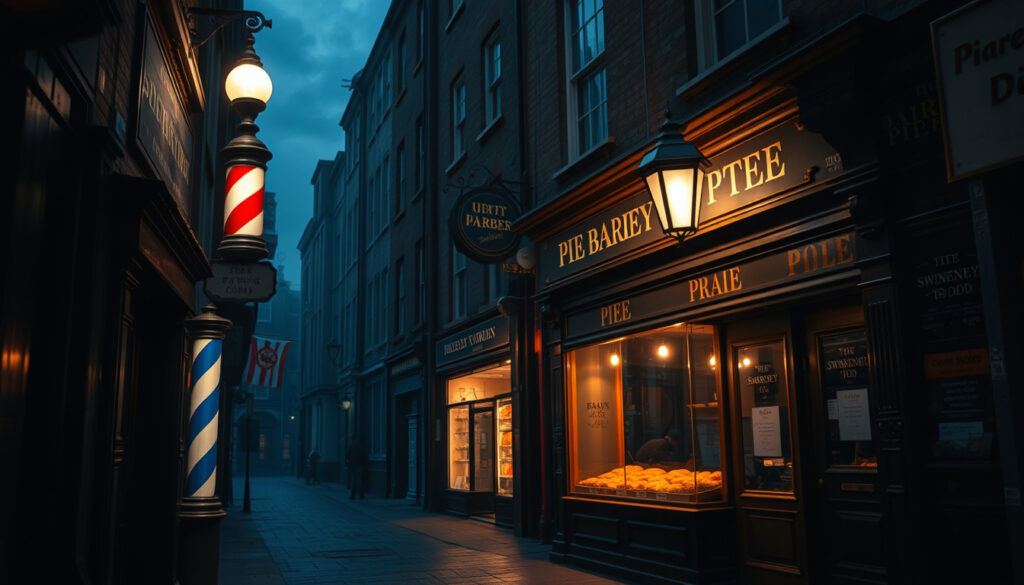
Sweeney Todd: Story, Real Inspiration, and Famous Lines Explained
Few characters in fiction blur the line between victim and predator quite like Sweeney Todd. A barber who slits throats and an accomplice who bakes bodies into pies—yet audiences still wrestle with whether to pity him. That tension is no accident: the demon barber has been evolving ever since his first appearance in an 1846 penny dreadful. Here’s what we know about where the story came from, what’s real, and what the musical’s famous lines actually mean.
First appearance: 1846–1847 (penny dreadful The String of Pearls) · Musical debut: 1979 (Broadway) · Notable film adaptation: 2007 (dir. Tim Burton, starring Johnny Depp) · Setting: Victorian London, Fleet Street · Character alias: Benjamin Barker
Quick snapshot
- Sweeney Todd is a fictional character introduced in The String of Pearls (Wikipedia – collaborative encyclopedia)
- The musical was written by Stephen Sondheim and Hugh Wheeler (MTI Shows – theatrical licensing authority)
- The 2007 film starred Johnny Depp and Helena Bonham Carter (Wikipedia – film entry)
- Whether any real London barber inspired the character (PBS/KQED – public broadcasting documentary)
- The exact origin of the urban legend (PBS/KQED – cultural history resource)
- Who wrote the original The String of Pearls (Wikipedia – author unknown)
- 1846–1847: First printed serial (Wikipedia)
- 1979: Broadway musical premiere (MTI Shows)
- 2007: Tim Burton film release (Wikipedia – film page)
- 2023 West End revival starring Josh Groban (MTI Shows – revival history)
- Continued adaptations in theatre and film (PBS/KQED)
Five facts, one pattern: nearly every key detail about Sweeney Todd—his origin, his crimes, his moral status—has been shaped by the medium that told it, from penny dreadful to stage to screen.
| Fact | Detail |
|---|---|
| First appearance | 1846–1847 (The String of Pearls) |
| Original author | Unknown (penny dreadful writer, possibly Thomas Peckett Prest – PBS/KQED) |
| Setting | Victorian London, Fleet Street |
| Musical composer | Stephen Sondheim (MTI Shows – licensing info) |
| Musical book writer | Hugh Wheeler (MTI Shows) |
| Film director | Tim Burton (Wikipedia – film entry) |
| Main actor (film) | Johnny Depp (Wikipedia) |
| Film release year | 2007 (Wikipedia) |
What’s the story behind Sweeney Todd?
The original penny dreadful
- Sweeney Todd first appeared as the villain of the penny dreadful serial The String of Pearls, published in 1846–1847 (Wikipedia – character history).
- The character was originally a murderous barber and villain in Victorian sensational fiction, not a hero (PBS/KQED – cultural context).
- Thomas Peckett Prest is credited by PBS as the writer who first set down Sweeney Todd’s name in print (PBS/KQED – authorship claim).
The serial was tailored to Victorian horror tastes, combining a barber who murdered customers with an accomplice, Mrs. Lovett, who disposed of bodies in her meat pies (PBS/KQED – plot summary).
The musical adaptation
- Christopher Bond’s 1973 play Sweeney Todd, the Demon Barber of Fleet Street gave Todd a psychological backstory centered on betrayal, exile, and revenge (MTI Shows – play history).
- Stephen Sondheim saw Bond’s play in 1973 and then conceived a musical version with a book by Hugh Wheeler (Wikipedia – musical development).
- The musical premiered on Broadway in 1979 (MTI Shows – premiere date).
“Attend the tale of Sweeney Todd.”
— Opening chorus, Sweeney Todd: The Demon Barber of Fleet Street (Goodreads – quote collection)
Bond’s rewrite transformed a cardboard villain into a tragic antihero with a motive audiences could almost root for. That revision set the stage for Sondheim’s haunting score—and for every debate about whether Todd is a monster or a man wronged.
The 2007 film
- Tim Burton directed the film adaptation, released in December 2007 (Wikipedia – film entry).
- Johnny Depp stars as Sweeney Todd, Helena Bonham Carter as Mrs. Lovett (Wikipedia – cast list).
- The film won the Academy Award for Best Art Direction (Wikipedia – awards).
What was Sweeney Todd accused of?
The crime of murder
- In the story, Todd was accused of murdering his customers after luring them into his barber chair (Wikipedia – plot summary).
- He used a hidden trapdoor to drop bodies into the basement (PBS/KQED – story details).
The legend of the barber’s victims
- His accomplice Mrs. Lovett used the bodies to fill her meat pies (PBS/KQED – cannibalism motif).
- The number of victims varies across versions, but the horror lies in the routine nature of the killings (Wikipedia – narrative treatment).
Historical accusations
- No public records substantiate the existence of a London barber named Todd in late-18th-century Fleet Street (PBS/KQED – historical check).
- Scholarship strongly disputes the existence of a historical Sweeney Todd, though possible legendary prototypes have been suggested (Wikipedia – historicity).
The story may have been inspired by an 1818 libel suit against scandal publisher James Catnatch, as PBS reports—a real legal case that fed the public appetite for lurid tales about barbers (PBS/KQED – true crime parallels).
The pattern: the accusations against Todd are entirely fictional, yet they echo real 19th-century urban legends—a blend of folklore and journalism that made the story feel disturbingly plausible.
Is Sweeney Todd based on a real thing?
Possible real-life inspirations
- A possible earlier motif appears in a 17th-century diary by Swedish traveler Pehr Lindeström, with a barber story set in Calais (Wikipedia – precursor motif).
- Another proposed precursor is an 1800 Paris narrative about Rue de la Harpe, later published in English as A Terrific Story of the Rue de la Harpe (Wikipedia – Paris precursor).
- PBS identifies several contemporaneous crimes that may have inspired Thomas Prest, including a December 1784 barber attack near Fleet Street (PBS/KQED – documented attack).
The myth of the Fleet Street barber
- The story circulated as a London legend and was later dramatized in multiple forms rather than preserved as a single stable historical account (PBS/KQED – legend evolution).
- PBS notes that many penny dreadfuls were fictionalized accounts of real crimes, which complicates attempts to map Sweeney Todd to a single real event (PBS/KQED).
The String of Pearls
- The original printed story was a penny dreadful published in serial form (PBS/KQED).
- PBS says Joseph Fouché’s police archives described an 1800 Parisian barber linked to pies made from victims, later republished in 1824 (PBS/KQED – police archive).
The catch: there is no verifiable real Sweeney Todd. The character is fictional, but the urban legend almost certainly drew on real crimes and folk tales—a patchwork of historical fears stitched into one enduring monster.
What is the famous line from Sweeney Todd?
“Attend the tale of Sweeney Todd”
- The opening line of the musical, sung by the chorus, immediately sets a theatrical framing device (Goodreads – lyrical quote).
- It invites the audience to listen to a dark story, much like an old campfire tale (Wikipedia – musical numbers).
Other notable quotes
- “There’s a hole in the world like a great black pit” – from the song “Epiphany” (Goodreads).
- “These are my friends” – Todd addressing his razors in the song “My Friends” (Goodreads).
Context of the line
- The opening line establishes the story as a tale to be told, not witnessed firsthand, creating distance between the audience and the horror (PBS/KQED – dramatic framing).
- It echoes the penny dreadful tradition of serialized storytelling, where each installment began with a call to attention (Wikipedia – serial format).
“These are my friends / See how they glisten.”
— Sweeney Todd, “My Friends” (Goodreads)
Why this matters: the lines are not just catchy—they define the character’s relationship to his tools and his mission. The razors become companions, while the world outside is the enemy.
Is Sweeney Todd a hero or villain?
Arguments for hero
- Stephen Sondheim explained the character’s dual nature as both victim and villain (MTI Shows – Sondheim interview references).
- MTI states that Bond’s version gave Todd a psychological backstory centered on betrayal, exile, and revenge (MTI Shows – Bond adaptation).
- Some viewers see him as a tragic figure driven mad by injustice.
Arguments for villain
- His actions (murder of innocent customers) clearly mark him as a criminal (Wikipedia – character analysis).
- He kills not only Judge Turpin (his target) but many unrelated people (PBS/KQED – body count).
The moral ambiguity
- The character embodies moral ambiguity, eliciting both sympathy and horror (PBS/KQED – moral reading).
- He is not a straightforward hero; the story forces audiences to confront their own capacity to empathize with a murderer (Wikipedia – thematic analysis).
The trade-off: the more human Todd seems, the harder it becomes to condemn him—and the more uncomfortable the story feels.
Timeline of Sweeney Todd
- : Serialization of The String of Pearls, introducing Sweeney Todd (Wikipedia)
- : Broadway premiere of Sweeney Todd: The Demon Barber of Fleet Street (MTI Shows)
- : Original Broadway cast album released (Wikipedia – recording)
- : Broadway revival opens (MTI Shows – revival history)
- : Film adaptation released, directed by Tim Burton (Wikipedia – film)
- : Off-Broadway revival by Tooting Arts Club (MTI Shows – revival)
- : West End revival with Josh Groban (MTI Shows – West End)
What’s confirmed and what’s still unclear
Confirmed facts
- Sweeney Todd is a fictional character (Wikipedia)
- The musical was written by Stephen Sondheim and Hugh Wheeler (MTI Shows)
- The 2007 film starred Johnny Depp (Wikipedia – film entry)
- The character first appeared in a penny dreadful in 1846 (PBS/KQED)
What’s unclear
- Whether any real barber inspired the character (PBS/KQED)
- The exact origin of the urban legend (PBS/KQED)
- The identity of the original author of The String of Pearls (Wikipedia)
“Sweeney Todd is not a real person, but the story is so vividly told that generations have wondered if it could be true.”
— Stephen Sondheim, in interviews (MTI Shows – Sondheim commentary)
For anyone trying to separate fact from fiction, the clearest conclusion is this: the demon barber belongs firmly in the realm of imagination, but the fears he represents—betrayal, revenge, urban danger—are all too real.
Related reading: **Harley Quinn: Origin, Psychology and Cultural Impact** · **Monty Python and the Holy Grail: Parody, Funding & Censorship**
bookriot.com, youtube.com, imdb.com, iheart.com, reddit.com, forum.broadwayworld.com, pcs.org
For a deeper dive into the character’s evolution, check out this complete guide to Sweeney Todd that traces his journey from penny dreadful to Broadway and film.
Frequently asked questions
Who composed the music for Sweeney Todd?
Stephen Sondheim composed the music and lyrics for the Broadway musical, which premiered in 1979 (MTI Shows).
What is the rating of the 2007 film Sweeney Todd?
The film is rated R for gory violence and disturbing content (Wikipedia – MPAA rating).
How long is the Sweeney Todd musical?
The running time is approximately 2 hours and 45 minutes, including one intermission (MTI Shows – show details).
Is Sweeney Todd appropriate for children?
No. The musical and film contain graphic violence, dark themes, and cannibalism, making it unsuitable for young audiences (Wikipedia – content advisory).
What awards did the Sweeney Todd musical win?
The original Broadway production won eight Tony Awards, including Best Musical, Best Score, and Best Book (MTI Shows – awards).
Where can I watch the 2007 Sweeney Todd film?
The film is available on digital platforms such as Amazon Prime, Apple TV, and Netflix, depending on region (Wikipedia – streaming availability).
What is the role of Mrs. Lovett in Sweeney Todd?
Mrs. Lovett is Todd’s accomplice who runs a failing pie shop. She helps him dispose of bodies by baking them into pies, and later becomes his love interest in the musical (Wikipedia – character description).
More related posts
 Strictly Come Dancing Vote: Complete Guide & Latest News
 Best Home Insurance UK 2026: Top Providers Compared
 Grace Charis: Biography, Age, Height, Net Worth & Golf Career
 Liam Tuffs: Podcast Host, Former Doorman, and The Dozen Explained
 Kate Garraway New Boyfriend – AI Hoax Rumors Debunked
 Why Call of Duty: Ghosts Flopped: Failure Explained
 Domain Checker: How to Look Up WHOIS, Age, and Spam
 Tottenham vs AFC Bournemouth Stats – H2H Records, Recent Results & Predictions