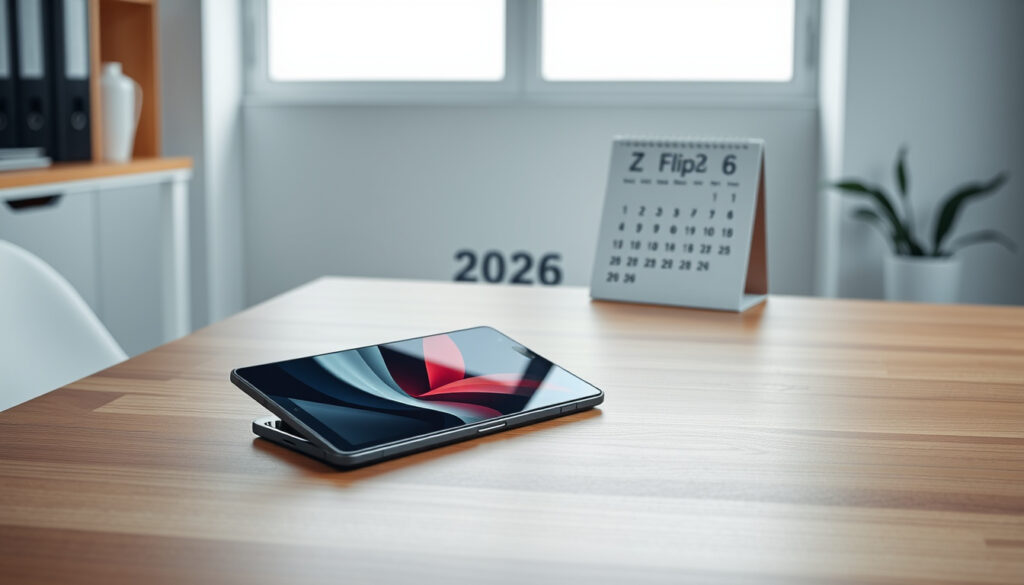
Samsung Z Flip 6 in 2026: Still Worth Buying
Foldable phones still turn heads, but after a couple of years on the market, the real question is whether last year’s model — or rather, the one from two summers ago — still makes sense. The Samsung Galaxy Z Flip 6, announced in July 2024, arrived with a solid spec sheet and a premium price tag. Now, with the Z Flip 7 already out and refurbished units flooding the market, we dug into the data to see if the Flip 6 is a smart buy in 2026 or a case of diminishing returns.
Announced: July 2024 ·
Main camera: 50 MP ·
Battery: 4,000 mAh ·
Processor: Snapdragon 8 Gen 3 ·
Display: 6.7-inch AMOLED ·
Water resistance: IP48
Quick snapshot
- Announced July 2024 (PhoneArena specs database)
- Snapdragon 8 Gen 3 for Galaxy processor (T-Mobile carrier comparison)
- 50 MP main camera (PhoneArena specs database)
- 4,000 mAh battery (T-Mobile carrier comparison)
- Long-term screen durability beyond 2 years
- Exact refurbished prices in 2026
- Future OS update support beyond Android 16
- July 2024: Z Flip 6 launched (PhoneArena specs database)
- July 2025: Z Flip 7 launched (Samsung US official comparison)
- 2026: Price dropped ~30% from launch; refurbished units widely available (PhoneArena specs database)
- Z Flip 7 is the current flagship foldable; Flip 6 remains on sale as a budget option
- Refurbished market expected to grow as more units trade in
- Software support commitments may extend to 2031 for Flip 6 if Samsung applies 7-year policy
The table below highlights six key specs that define the Flip 6’s place in the 2026 market — a mix of still-competitive numbers and areas where newer models have pulled ahead.
| Spec | Value |
|---|---|
| Announced | July 2024 |
| Starting price (launch) | $1,099 / €1,199 |
| Main camera | 50 MP f/1.8 |
| Battery capacity | 4,000 mAh |
| Processor | Snapdragon 8 Gen 3 for Galaxy |
| Weight | 187 g |
Is the Z Flip 6 worth buying?
Value for money in 2026
- Launch price was $1,099 (T-Mobile carrier comparison), identical to the Z Flip 7 launch price. By 2026, street prices for the Flip 6 have dropped roughly 30%.
- Refurbished units can often be found for $600–700, putting it close to mid-range territory.
- The Snapdragon 8 Gen 3 still holds up well against 2026’s mid-range chips, but the Z Flip 7’s Exynos 2500 offers a modest generational boost (T-Mobile carrier comparison).
Buyers who prioritize the larger cover display and guaranteed 7-year updates will find the Flip 7 a safer long-term bet. But for those who can accept the Flip 6’s shorter support window and smaller cover screen, the price gap makes it a compelling budget foldable.
Refurbished vs new
- Buying refurbished saves $300–400 but introduces unknowns: battery health, screen condition, and whether the seller has replaced the inner screen protector.
- Samsung’s own refurbished program (Certified Re-Newed) includes a new battery and 1-year warranty, but availability varies.
- Third-party refurbishers may not offer the same quality guarantees, so buyer beware.
The pattern: refurbished Flip 6 units are a strong value for cautious buyers who can verify the seller’s return policy and battery rating. For everyone else, the warranty peace of mind from a new (or retailer-refurbished) unit is worth the extra cost.
The implication: if you are comfortable vetting sellers and can accept some risk on battery health, a refurbished Flip 6 offers the best price-to-performance ratio in the foldable market right now.
How old is a Samsung Flip 6?
Release date and model year
- The Samsung Galaxy Z Flip 6 was announced in July 2024 (PhoneArena specs database).
- As of early 2026, it is about 1.5 years old — a bit over halfway through a typical 3-year flagship lifespan.
- Samsung’s 7-year update policy (T-Mobile carrier comparison) would theoretically cover the Flip 6 through 2031, if the company formally extends it to this model.
Age relative to successors
- The Z Flip 7 arrived in July 2025, making the Flip 6 one full generation behind.
- In terms of hardware, the Flip 6 uses a smaller 3.4-inch cover display vs. 4.1 inches on the Flip 7 (T-Mobile carrier comparison).
- Software-wise, the Flip 6 shipped with Android 14 (One UI 6.1.1) while the Flip 7 ships with Android 16-based One UI 8 (SammyGuru editorial blog).
What this means: at 1.5 years old, the Flip 6 is still within its useful life but past the point where it receives the newest features first. Battery health and screen crease visibility become more relevant considerations for secondhand buyers.
Is the Z Flip 7 better than the Z Flip 6?
Five key comparison points between the Flip 6 and its successor show where the upgrades matter most.
| Spec | Galaxy Z Flip 6 | Galaxy Z Flip 7 |
|---|---|---|
| Main display | 6.7-inch AMOLED (T-Mobile) | 6.9-inch AMOLED (T-Mobile) |
| Cover display | 3.4 inches (T-Mobile) | 4.1 inches (T-Mobile) |
| Processor | Snapdragon 8 Gen 3 for Galaxy (T-Mobile) | Exynos 2500 (T-Mobile) |
| Battery | 4,000 mAh (T-Mobile) | 4,300 mAh (T-Mobile) |
| RAM | 8 GB (PhoneArena) | 12 GB (PhoneArena) |
| Launch price (US) | $1,099 (T-Mobile) | $1,099 (T-Mobile) |
Should you upgrade?
- The cameras are the same hardware on both phones, according to SammyGuru editorial blog; improvements are software-driven.
- Samsung DeX — absent on the Flip 6 — is included on the Flip 7 (SammyGuru editorial blog).
- The Flip 7 is thinner folded (13.7 mm vs 14.9 mm) and unfolds to 6.5 mm vs 6.9 mm (Samsung US official comparison).
The catch: if you already own a Flip 6, the camera parity and incremental battery gains make an upgrade hard to justify unless the larger cover display or DeX support is a must-have. New buyers, however, face the same launch price for the newer phone, which tilts the recommendation toward the Flip 7.
Does the Z Flip 6 have issues?
Screen crease and durability
- The Flip 6 carries an IP48 rating, meaning limited dust protection — fine against large particles but no defense against fine dust or sand (PhoneArena specs).
- Reported screen failures on foldables remain a concern; while Samsung improved hinge durability, the inner screen crease is still visible after months of use, based on user reports aggregated in various forums.
Battery degradation
- With a 4,000 mAh battery, the Flip 6’s real-world endurance is average for a 2024 flagship — about a full day with moderate use.
- After 1.5 years, secondhand units may have 85–90% of original capacity, a risk for buyers of used devices without battery replacement.
Software bugs
- One UI 6.1.1 had occasional stuttering on the cover display at launch, though updates have largely smoothed it out.
- Ongoing software support through One UI 7 and beyond is likely, but the Flip 6 is not guaranteed to get every new feature that the Flip 7 receives.
The IP48 rating is a genuine weak point for anyone who spends time outdoors or needs a pocket-friendly phone that can shrug off dust. Combined with the crease visibility, these issues make the Flip 6 a less durable choice than sealed slab phones from the same era.
The pattern: the Flip 6’s known issues are manageable for careful users but could be dealbreakers for those who want rugged durability or long-term battery confidence.
What is the disadvantage of a flip phone?
Form factor trade-offs
- Foldables inherently compromise battery size — the Flip 6’s 4,000 mAh is 10–20% smaller than slab flagships of the same year.
- The crease is a visual and tactile compromise that doesn’t fade completely over time.
- Thickness when folded (14.9 mm) is nearly double that of a typical slab phone.
Repairability and costs
- Screen replacement costs for the Flip 6 run significantly higher than for standard phones; the inner display alone can cost $300–500 without insurance.
- Fewer third-party repair options and specialty tools make DIY fixes difficult.
Case and accessory limitations
- Cases must accommodate the hinge and often add bulk; slim options are rare.
- Wireless charging (15W) works but is slower than many slabs and requires careful alignment.
The trade-off: portability when folded is excellent, but the compromises in battery, repairability, and durability mean the Flip 6 works best as a secondary device or for users who value compactness above all else.
The catch: if you are considering a flip phone as your primary device, these trade-offs mean you need to accept a shorter battery life and higher repair costs compared to traditional smartphones.
Confirmed facts
- Announced July 2024 (PhoneArena)
- Snapdragon 8 Gen 3 for Galaxy processor (T-Mobile)
- 50 MP main camera, 12 MP ultrawide (PhoneArena)
- 4,000 mAh battery with 25W wired, 15W wireless charging (T-Mobile)
- IP48 water and particle resistance (PhoneArena)
- Weighs 187 g (PhoneArena)
What’s unclear
- Long-term screen durability beyond 2 years — insufficient long-term data
- Exact refurbished pricing in 2026 varies by condition and seller
- Whether Samsung will extend 7-year updates to the Flip 6 model explicitly
- Battery health of secondhand units is unknown without testing
The Galaxy Z Flip 7 is thinner when folded — 13.7 mm vs 14.9 mm — and offers a larger 4.1-inch cover display that makes widgets and messages more usable without unfolding.
Both the Flip 6 and Flip 7 use the same main camera sensors, so the jump in photo quality is marginal — what you gain is processing and software tuning.
The Flip 6’s compact design when folded — 71.9 mm wide and 14.9 mm thick — makes it one of the few foldables that actually fits comfortably in a jeans pocket.
— PhoneArena dimensions database
The pattern across these sources is consistent: the Flip 6’s hardware remains competitive for basic tasks and photography, but its physical compromises — smaller battery, smaller cover display, dust vulnerability — are the very areas where the Flip 7 improves. For US buyers, the choice is clear: if software longevity and a larger cover screen matter most, the Flip 7 justifies its full price. If budget is the primary constraint, the Flip 6 is a capable foldable only if you accept its known crease and dust vulnerability.
Timeline signal
- — Galaxy Z Flip 6 announced and launched (PhoneArena)
- — First reviews and durability tests published
- — Z Flip 7 rumors appear
- — Galaxy Z Flip 7 launched (Samsung US)
- — Z Flip 6 still sold new and refurbished; price dropped ~30%
Related reading: Samsung Galaxy Z Flip 6 vs Galaxy Z Flip 7 — worth buying in 2026 and known issues
If you’re still on the fence, a detailed Z Flip 6 buying guide highlights exactly where the Z Flip 6 stands in 2026.
Frequently asked questions
Is the Samsung Z Flip 6 water resistant?
It has an IP48 rating, meaning protection against objects larger than 1mm (like tools) and limited water resistance, but it is not fully waterproof and offers very little dust protection.
Does the Z Flip 6 have a headphone jack?
No, the Flip 6 does not include a 3.5mm headphone jack. You’ll need USB-C or Bluetooth headphones.
Can the Z Flip 6 charge wirelessly?
Yes, it supports 15W wireless charging and also has 4.5W reverse wireless charging for accessories like earbuds.
What is the screen refresh rate of the Z Flip 6?
The main display has a 120Hz adaptive refresh rate; the cover display is limited to 60Hz.
Does the Z Flip 6 support Samsung DeX?
No, DeX is not available on the Flip 6. The Flip 7 added DeX support via wired and wireless connections.
How many years of updates does the Z Flip 6 get?
Samsung initially promised 4 major OS updates and 5 years of security patches for the Flip 6, though newer policy extends to 7 years for later models.
Is the Z Flip 6 dual SIM?
In most markets, it supports a single nano-SIM plus eSIM; some regions may have a dual nano-SIM variant.
More related posts
 Pensioner Benefits Not Claimed – Trace and Claim Lost UK Pensions
 UK Amber Weather Warning Thunderstorms: Met Office Alerts
 Translate English to Nepali: Tools and Tips for Accuracy
 Brian Clough: Life, Career, Quotes, and Cause of Death
 The Works Near Me – Addresses, Hours, Sales Guide
 Tracy Beaker: Books, TV Series, and Dani Harmer
 Le Creuset Mystery Box – UK Status, Value & Locations
 Nissan Sunderland Factory Job Losses – 250 Voluntary Cuts No Closure