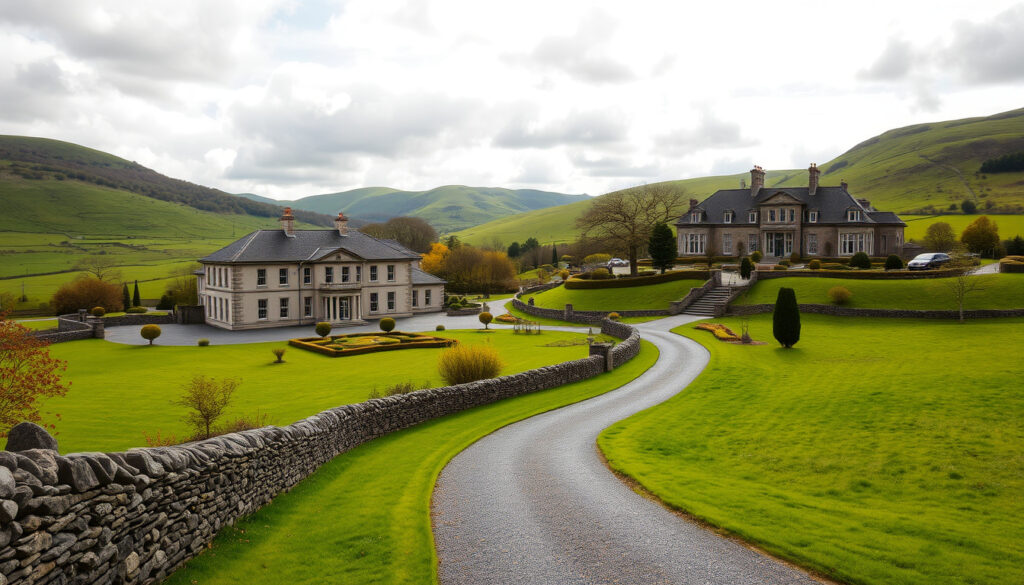
Stately Homes Near Me in Ireland: Manor vs. Stately Home Guide
Few things say “Irish heritage” like a grand country house set behind wrought-iron gates, but the term ‘stately home’ is often used loosely. This guide uses official Heritage Ireland and Historic Houses of Ireland sources to untangle the jargon and help you find genuine heritage properties open to the public across the island.
Stately homes in Ireland open to the public: Over 30 properties managed by the Office of Public Works and Heritage Ireland · Largest mansion in Ireland: Castle Ward (County Down) at 820 acres, or Muckross House (Killarney) depending on definition · Medieval walled towns in Ireland: At least 12 towns in the Irish Walled Towns Network, including Kilkenny, Derry, and Limerick · Tier 1 source for stately homes: Heritage Ireland
Quick snapshot
- Castletown House is the largest Palladian country house in Ireland (Heritage Ireland)
- Derrynane House was the home of Daniel O’Connell (Heritage Ireland)
- Irish Walled Towns Network includes at least 12 towns (Discover Ireland)
- Exact number of privately owned stately homes in Ireland not publicly inventoried
- Which individual property is the “biggest mansion” depends on metric (acreage vs. floor area)
- Contemporary usage of “stately home” vs. “manor house” by tourism boards varies
- Irish Landmark Trust marked 30 years of saving historic buildings in 2022 (Irish Landmark Trust)
- Check opening times before visiting – many houses close for winter months
- New properties may be added to Heritage Ireland’s list as restoration projects finish
A visitor searching “stately homes near me” on Google will mostly find heritage-listed properties, but the term also appears in marketing for private estates and wedding venues. The safest bet: stick to the official Heritage Ireland list, which guarantees public access and conservation standards.
The table below summarizes the key data points from official sources.
| Fact | Detail | Source |
|---|---|---|
| Largest Palladian house in Ireland | Castletown House (County Kildare) | Heritage Ireland |
| Properties in Heritage Ireland network | Over 30 stately homes, gardens, and historic houses | Heritage Ireland |
| Official Irish Walled Towns Network members | At least 12 towns | Discover Ireland |
| Most visited stately home (by data availability) | Russborough House (County Wicklow) | Ireland.com |
| Heritage Ireland stately-home sites listed | 8 | Heritage Ireland |
| Historic Houses of Ireland membership | Hundreds of privately owned houses and castles | Historic Houses of Ireland |
| Northern Ireland grand houses grouped | Castle Ward, Hillsborough Castle, Castle Coole, Mount Stewart, Florence Court, The Argory | Discover Northern Ireland |
| Irish Landmark Trust anniversary | 30 years of saving buildings (2022) | Irish Landmark Trust |
What is the difference between a manor house and a stately home?
The terms are often used interchangeably in tourism marketing, but historically they refer to different tiers of land ownership and house size. A manor house was the seat of the local gentry, typically a large house with agricultural land, while a stately home was built by the aristocracy on an even grander scale – often designed by renowned architects and set in sweeping parklands.
One key pattern: many manor houses in Ireland have been converted into hotels or private residences, whereas the official Heritage Ireland stately homes collection prioritises properties that remain open to the public with original furnishings. The table below captures the main structural and historical differences.
A user searching “stately homes near me” who ends up at a manor house-turned-hotel may be disappointed if they expected a preserved heritage experience. Knowing the difference saves time and ensures the visit matches expectations.
| Feature | Manor house | Stately home |
|---|---|---|
| Original owners | Local gentry (squires) | Aristocracy (lords, earls) |
| Typical size | Medium, often 10–30 rooms | Large, 30+ rooms |
| Architectural style | Medieval, Tudor, Georgian | Georgian, Palladian, Neoclassical |
| Land attached | Farmland, a few hundred acres | Parkland, hundreds to thousands of acres |
| Common current use in Ireland | Hotel, private home, or derelict | Museum, tourist attraction, or private residence open by appointment |
| Official listing body | Historic Houses of Ireland (private) | Heritage Ireland (state) and Irish Landmark Trust |
The pattern: The Irish stately landscape is a pyramid – a small number of state-managed properties at the top (Heritage Ireland’s eight sites) and a much wider base of privately owned manor houses and castles that may or may not welcome visitors. Understanding this hierarchy is the first step to planning a reliable heritage outing.
When is a stately home not a stately home?
A property marketed as a “stately home” may be a private estate used for weddings, a hotel that once housed gentry, or even a derelict shell. The line becomes blurry because there is no statutory definition in Ireland – the term is used by tourism boards, estate agents, and event venues alike.
To cut through the noise, use these three filters:
- Check the official listing: If it appears on Heritage Ireland’s stately-homes page (the state heritage body), it is a genuine public-access heritage site.
- Look for conservation status: Properties managed by the Irish Landmark Trust (the buildings-preservation charity) are holiday rentals but are fully restored and open to visitors.
- Read the small print: If the website mentions “weddings” or “events” more than “history” or “tour,” the property is likely a commercial venue using the stately-home label for marketing.
The catch: Many of the most photographed Irish mansions – like Castletown House (described by Frommer’s as the country’s most imitated building) – are genuine stately homes, but smaller houses in the same area may borrow the label loosely. Always verify the owner and purpose before visiting.
What are some famous stately homes in Ireland?
Ireland’s best-known stately homes are concentrated in the midlands and south-east, but a few are in the west and north. All the properties listed below are either state-managed or open to the public on a regular schedule.
Castletown House and Parklands
- County: Kildare
- Era: Early 18th century
- Claim: Largest Palladian country house in Ireland – Heritage Ireland
- Open: Yes, with guided tours and walled gardens
Doneraile Court
- County: Cork
- Era: Mid-18th century
- Claim: Restored Georgian house set in 17-acre deer park – Heritage Ireland
- Open: Yes, free entry to parklands
Derrynane House
- County: Kerry
- Era: 18th century
- Claim: Home of Daniel O’Connell, “The Liberator” – Heritage Ireland
- Open: Yes, with National Park and beach
Russborough House
- County: Wicklow
- Era: Mid-18th century
- Claim: Owned by the Alfred Beit Foundation and open to public – Ireland.com
- Open: Yes, tours and fine arts collection
Two of these four properties (Doneraile Court and Derrynane House) are part of the Heritage Ireland stately-homes collection, while Castletown and Russborough are managed by independent trusts. A visitor relying solely on Heritage Ireland’s list would miss Russborough, which is one of the most visited stately homes in the country.
The pattern: Official lists are not exhaustive; supplementing with trust-managed properties broadens the visit options.
Where do the wealthy elite live in Ireland?
The highest concentration of wealth sits in Dublin’s southside suburbs and coastal towns, but some of the grandest houses remain in private hands across the country. Irish Tourism (the private travel guide) notes that many manor-house hotels “charming luxury manor hotels and boutique countryside properties” are now owned by wealthy families who offer limited access.
While Dublin 4, Killiney and Dalkey are the traditional addresses for Ireland’s elite, many stately homes in rural counties – especially Wicklow, Kildare and Waterford – are still owned by descendants of the original families. These are rarely open to the public unless part of a heritage scheme.
A Former Glory (the Irish heritage blog) round-up of accessible houses in Dublin includes Malahide Castle, Newbridge House & Farm, and Ardgillan Castle – all open to the public and within 30 minutes of the city centre.
The implication: Stately homes in rural counties are often privately owned, making the small number of public-access properties in Heritage Ireland even more valuable.
Are there any medieval towns in Ireland?
Yes – and they often sit beside or near stately homes, making them a natural pairing for a heritage day out. The Irish Walled Towns Network (coordinated by the Heritage Council) includes at least 12 towns with surviving medieval walls.
- Kilkenny – best-preserved medieval town, with Kilkenny Castle
- Derry – only completely walled city in Ireland
- Limerick – walled King’s Island quarter
- Athenry – well-preserved medieval walls and a castle
Many of these towns have a stately home or country house within a short drive – for example, Castletown House is 15 minutes from Kilkenny, and Derrynane is near the walled town of Carlingford (though Carlingford’s walls are less complete).
What this means: Combining walled town visits with nearby stately homes creates a full heritage itinerary.
How to find stately homes near me in Ireland
Use these five steps to turn a vague search into a plan.
- Open the Heritage Ireland stately-homes page: Start with their interactive map – it marks all eight official sites across the country.
- Browse Historic Houses of Ireland: Their directory lists properties open by appointment or seasonally.
- Use Discover Ireland’s houses and gardens section: The tourism board groups properties by region and marks free entry.
- Check the Irish Landmark Trust: Their rental portfolio includes tower houses, gate lodges and lighthouses – many available for overnight stays.
- Search Google Maps with filters: Type “historic house” or “stately home” and add “open to public” in the search field. Cross-check the results with the official lists above.
What qualifies a house as a château?
“Château” is a French term for a country house or castle, and has no official use in Irish classification. However, a handful of Irish properties – especially those built in a French style or marketed to international tourists – have adopted the label. Irish Tourism (the private guide) notes that some manor-house hotels use “château” to evoke continental luxury rather than Irish heritage.
In practice, a “château” in Ireland is almost always a stately home or manor house that has been converted into high-end accommodation. It does not meet any official heritage definition and should be treated as a commercial branding choice.
The more “château” a property sounds, the less likely it is to be a genuine heritage site. The real Irish stately homes are usually called “house” – Castletown House, Doneraile Court, Derrynane House – not châteaux.
The pattern: Irish heritage properties avoid the term ‘château’.
Which country has 30,000 castles?
A common related query, but largely a tangent for those searching “stately homes near me.” Germany is often credited with roughly 25,000 castles, while Ireland has over 30,000 castle and tower house sites – most of them ruins. This figure is often cited in trivia lists and is not directly relevant to finding a stately home that is open to the public. The key distinction: a castle is fortified, a stately home is residential.
Quotes from experts
“Heritage Ireland describes stately homes as one of the pinnacles of Ireland’s early modern architectural achievement, expressed through stately homes and their associated formal gardens across the country.”
— Heritage Ireland (the state heritage body)
“Historic Houses of Ireland informs the public about Ireland’s historic-house cultural resource.”
— Historic Houses of Ireland (the national membership organisation)
“Discover Northern Ireland groups Castle Ward, Hillsborough Castle and Gardens, Castle Coole, Mount Stewart, Florence Court, and The Argory under its grand houses and gardens section.”
For anyone planning a heritage visit, the distinction between a genuine state-managed property and a privately owned estate with limited access is the difference between a satisfying day out and a closed gate. The Irish stately-landscape is rich, but it requires a map – literally and definitionally. Use Heritage Ireland as your starting point, the Walled Towns Network as your cultural backbone, and treat any property that calls itself a “château” with healthy scepticism.
Frequently asked questions
Are stately homes in Ireland free to enter?
Many Heritage Ireland stately homes offer free entry to parklands and gardens, but guided tours of the house interior usually carry a fee. Doneraile Court’s deer park is free, while Castletown House charges for the house tour.
Can I stay overnight in a stately home in Ireland?
Yes – the Irish Landmark Trust offers holiday rentals in restored towers and gate lodges. Some privately owned stately homes also operate as luxury B&Bs, but availability varies.
Do stately homes in Ireland have restaurants or cafés?
Most Heritage Ireland stately homes have on-site cafés during opening months. Castletown House, Doneraile Court and Derrynane House all have tea rooms.
What is the dress code for visiting a stately home in Ireland?
No formal dress code, but practical shoes are recommended – many houses have gravel paths and multiple staircases. Some historic floors require soft-soled shoes.
Are there stately homes in Ireland that allow dogs?
Policy varies by property. Heritage Ireland sites generally allow well-behaved dogs on leads in parklands but not inside the house. Check the individual property page before visiting.
How do I find stately homes near me in Ireland using Google Maps?
Type “heritage house” or “stately home” into Google Maps and filter by “open now”. Verify the property appears on the Heritage Ireland list before relying on the pin.
What are the opening hours for Heritage Ireland stately homes?
Most are seasonal – open from mid-March to late October, typically 10:00–17:00. Winter opening is rare; check Heritage Ireland for exact dates.
More related posts
 Where Is Hot in December – Best Winter Sun Spots
 Leyton Orient F.C. – History League Two Status Key Facts
 Tracy Beaker: Books, TV Series, and Dani Harmer
 Justin Gaethje: Record, Age, Net Worth, and Future Fights
 Luton Town vs Coventry: Rivalry, History, and 2023 Play-off Final
 Iain Armitage: Age, Net Worth, and the Nepo Baby Question
 Prince Harry UK Return – Invictus 2027 Reconciliation Explained
 B&Q Halifax Contact, Services & Store Details