James VI and I – Life, Reign, Family and Legacy
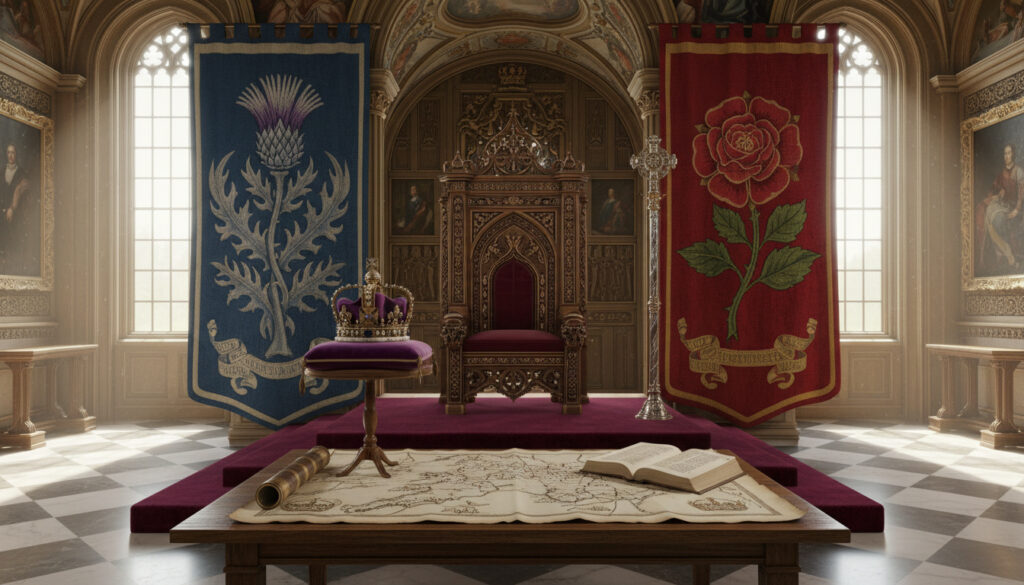
James VI and I (James Charles Stuart, 19 June 1566 – 27 March 1625) remains one of British history’s most singular monarchs. Ascending the Scottish throne at thirteen months old following his mother’s forced abdication, he governed Scotland for nearly six decades before inheriting the English crown from his cousin Elizabeth I. This unprecedented dual reign established the Union of the Crowns, creating a personal union between the kingdoms of Scotland and England while they retained separate parliaments and legal systems.
His reign bridged the Tudor and Stuart dynasties, encompassing the translation of the Bible that bears his name, the colonization of North America, and the Gunpowder Plot. Yet beneath these monumental achievements lay a personal history marked by political calculation, religious maneuvering, and family tragedy. What Is Hamilton About – Plot, History and Popularity Guide explores similar dynastic transitions in theatrical form.
Who Were James VI and I’s Children?
Key Insights
- Longest-reigning Scottish monarch at nearly 58 years
- Only three of seven children survived infancy
- Eldest son Henry Frederick died of typhoid in 1612, altering the succession
- Daughter Elizabeth became the “Winter Queen” of Bohemia through her marriage to Frederick V, Elector Palatine
- Second son Charles I succeeded him but was later executed in 1649
- Marriage to Anne of Denmark in 1590 produced the heir and spares
- Several children including Sophia died in early childhood, reflecting high infant mortality among royalty
| Full Name | James Charles Stuart |
|---|---|
| Birth | 19 June 1566, Edinburgh Castle |
| Father | Henry Stuart, Lord Darnley |
| Mother | Mary, Queen of Scots |
| Consort | Anne of Denmark (married 1590) |
| Children Total | 7 (3 survived infancy) |
| Sons Who Reached Adulthood | Henry Frederick (d. 1612), Charles I |
| Daughter Who Reached Adulthood | Elizabeth (1596–1662) |
| Scottish Reign | 24 July 1567 – 27 March 1625 |
| English Reign | 24 March 1603 – 27 March 1625 |
| Successor | Charles I |
James married Anne of Denmark, sister of King Christian IV, in 1590. Their first son, Henry Frederick, was born in 1594 and became Prince of Wales, but died prematurely of typhoid fever in 1612. This tragedy elevated the second son, Charles, from an unexpected position to heir apparent. Their daughter Elizabeth married Frederick V, Elector Palatine, and earned the moniker “Winter Queen” after their brief reign as King and Queen of Bohemia in 1619–1620. Wikipedia provides extensive genealogical documentation.
What Was James VI and I’s Religion?
Raised in the Protestant faith from infancy, James VI and I navigated the treacherous religious politics of both Scotland and England with pragmatic dexterity. Crowned in a Protestant service at Stirling on 29 July 1567, he maintained doctrinal allegiance to the Church of England while resisting Puritan demands for further reform.
The Hampton Court Conference
The Hampton Court Conference of 1604 proved pivotal to English religious history. Convened to address tensions between the Anglican establishment and Puritan reformers, the conference instead resulted in the commissioning of the Authorized Version of the Bible—commonly known as the King James Bible. Completed in 1611, this translation standardized English Protestant worship and remains in liturgical use today. Britannica details his theological positioning between Catholic and Puritan extremes.
Scottish Religious Policy
In Scotland, James balanced the interests of Presbyterian reformers with residual Catholic nobility through factional management, including the Octavians (1596–97). While he navigated these divides pragmatically, he firmly opposed Puritan attempts to restructure the Kirk along more radical lines. His theological writings, including Basilicon Doron, outlined a theory of divine right kingship that would prove increasingly problematic in his later conflicts with Parliament.
The King James Bible, commissioned at the Hampton Court Conference, emerged from the translation work of 47 scholars working in six committees. Published in 1611, it became the standard English Bible for Protestant churches and influenced English literature and language for centuries.
When and Where Was James VI and I Born?
Born at Edinburgh Castle on 19 June 1566, James entered the world amid the factional violence that characterized his mother’s reign. His father, Henry Stuart, Lord Darnley, would be assassinated within a year at Kirk o’ Field, while his mother, Mary, Queen of Scots, would be forced to abdicate in favor of her infant son on 24 July 1567.
Early Separation from Mary
Crowned at Stirling on 29 July 1567 in a Protestant service, James never saw his mother again after she fled to England in 1568. Her subsequent imprisonment and execution in 1587 drew only formal protests from James, who prioritized maintaining diplomatic ties with Elizabeth I over filial loyalty. National Museums Scotland preserves artifacts from his Scottish coronation.
Despite being only thirteen months old when separated, James maintained a political rather than emotional response to his mother’s fate. When Elizabeth I executed Mary in 1587, James issued formal diplomatic protests while ensuring no actual rupture occurred in Anglo-Scottish relations.
Death and Final Illness
James died at Theobalds House in Hertfordshire on 27 March 1625, aged 58. Contemporary accounts suggest a combination of chronic ailments: severe gout, kidney complications possibly exacerbated by mercury treatments, arthritis, and either dysentery or a urinary tract infection. He had been in declining health for several months before his death. Encyclopedia Virginia documents his final months and medical treatments.
While primary sources agree on his symptoms—gout, kidney pain, and intestinal distress—the exact pathological cause remains debated. Some historians suggest porphyria or complications from mercury poisoning administered as treatment, while others favor dysentery or urinary sepsis.
Who Succeeded James VI?
Charles I inherited the thrones of England, Scotland, and Ireland upon his father’s death. This second son had not been the heir apparent until 1612, when his elder brother Henry Frederick died of typhoid fever at age 18. The shift in succession proved historically consequential—Charles I’s rigid belief in absolute divine right kingship, inherited from his father’s writings in Basilicon Doron, ultimately led to the English Civil War and his own execution in 1649.
The succession followed the Stuart line through the male heirs, bypassing the female line represented by James’s daughter Elizabeth, who had married into the Palatine branch of German royalty. National Library of Scotland exhibits document this dynastic transition.
How Is James VI and I Depicted in Movies?
Despite his historical significance in uniting the crowns and commissioning the most influential English Bible translation, James VI and I has rarely been the subject of major cinematic biopics. No feature films directly titled on him are noted in historical records, though his era inspired Shakespeare’s The Tempest, possibly written in response to news of the Jamestown shipwreck reaching London.
Modern cultural engagement includes the 2024 biography The Mirror of Great Britain by Clare Jackson, which portrays the monarch empathetically, and documentary work by historian Steven Veerapen exploring his life and legacy. YouTube lectures by academic historians provide the most accessible visual exploration of his reign. Hamilton Book publishes recent scholarly treatments.
Timeline of James VI and I’s Life and Reign
- : Born at Edinburgh Castle to Mary, Queen of Scots, and Henry Stuart, Lord Darnley
- : Accession as James VI; coronation at Stirling in Protestant rite
- : Mother flees to England; James never sees her again
- : Escapes Protestant captors (Ruthven Raid) to rule independently
- : Mary, Queen of Scots executed; James offers formal protest only
- : Marriage to Anne of Denmark at Oslo and Copenhagen
- : Birth of Henry Frederick, Prince of Wales
- : Birth of Elizabeth, future “Winter Queen”
- : Birth of Charles I, eventual successor
- : Accession as James I of England; Union of the Crowns begins
- : Hampton Court Conference commissions King James Bible
- : Gunpowder Plot discovered November 5
- : Jamestown founded under Virginia Company charter
- : Death of Henry Frederick; Charles becomes heir apparent
- : Only return visit to Scotland during English reign
- : Death at Theobalds House, Hertfordshire
What Facts Are Certain About James VI and I’s Death?
Established Information
- Died 27 March 1625 at Theobalds House, aged 58
- Buried at Westminster Abbey
- Succeeded by second son Charles I as King of England, Scotland, and Ireland
- Chronic ill health preceded death by several months
- Suffered from severe gout and arthritis in final years
Information That Remains Unclear
- Exact pathological cause (dysentery vs. kidney failure vs. gout complications)
- Whether porphyria contributed to symptoms
- Role of mercury poisoning from medical treatments
- Specific urinary tract infection diagnosis vs. general dysentery
How Did the Union of the Crowns Change Britain?
The accession of James VI to the English throne in 1603 created a personal union unprecedented in British history. While Scotland and England remained legally separate sovereign states with distinct parliaments, coinage, and legal systems, they shared a single monarch for the first time. James styled himself “King of Great Britain and Ireland,” advocating for a full political union including a single parliament—a goal not achieved until the 1707 Acts of Union.
His reign initiated the Plantation of Ulster, reshaping Irish demographics through organized Scottish and English settlement. The Virginia Company’s charter led to permanent English settlement in North America at Jamestown (1607), establishing the colonial precedent that would expand into the thirteen colonies. Newspaper – Ancient Origins, Types and Digital Challenges traces how news of these colonial ventures spread through early modern media.
The Jacobean age fostered a literary renaissance, with Shakespeare, Donne, Jonson, and Bacon producing works under his patronage. Yet his belief in divine right absolutism, articulated in Basilicon Doron and The True Law of Free Monarchies, created friction with Parliament that his son would inherit, ultimately leading to constitutional crisis and civil war.
What Do Primary Sources Reveal About James VI and I?
“The state of monarchy is the supremest thing upon earth; for kings are not only God’s lieutenants upon earth, and sit upon God’s throne, but even by God Himself they are called gods.”
James VI and I, The True Law of Free Monarchies (1598)
“I am the husband, and the whole isle is my lawful wife; I am the head, and it is my body.”
James I, addressing Parliament regarding the Union of the Crowns (1603)
What Is the Historical Legacy of James VI and I?
James VI and I stands as the linchpin between medieval and modern Britain, the only monarch to rule both Scotland and England as separate kingdoms under one crown. His 58-year Scottish reign and 22-year English reign saw the consolidation of Protestant identity through the King James Bible, the establishment of permanent English colonies in America, and the first steps toward British union. Yet his legacy remains bifurcated: celebrated for cultural patronage and religious scholarship, while criticized for the absolutist tendencies that precipitated his son’s catastrophic conflict with Parliament. Museum collections preserve the material culture of his dual court.
Frequently Asked Questions
What was James VI and I’s family tree?
James was the only child of Mary, Queen of Scots, and Henry Stuart, Lord Darnley. He married Anne of Denmark (sister of Christian IV) in 1590. Their three surviving children were Henry Frederick (d. 1612), Charles I (successor), and Elizabeth (who married Frederick V of the Palatinate).
How many children did James VI and I have?
James and Anne of Denmark had seven children total, but only three survived infancy: Henry Frederick (1594–1612), Elizabeth (1596–1662), and Charles I (1600–1649). Other children including Sophia died young.
What was the Gunpowder Plot?
The 1605 Gunpowder Plot was a failed attempt by Catholic conspirators led by Guy Fawkes to blow up Parliament and kill James I during the state opening. Discovery of the plot on November 5 became an annual commemoration.
Where is James VI and I buried?
James was buried at Westminster Abbey in London. His tomb lies near the tombs of Elizabeth I and Mary, Queen of Scots (moved there by his command), uniting the rival queens in death if not in life.
Did James VI and I ever visit Scotland after 1603?
Yes, but only once. He returned to Scotland in 1617, the only visit during his English reign. He based his court primarily in England, considering it wealthier and more politically significant than Edinburgh.
What is the King James Bible?
Commissioned at the 1604 Hampton Court Conference, this 1611 translation became the Authorized Version for the Church of England. Forty-seven scholars produced it, creating the dominant English biblical text for centuries.
How long did James VI and I reign in Scotland?
James reigned as King of Scotland from 24 July 1567 until his death on 27 March 1625—nearly 58 years, the longest reign of any Scottish monarch.
Was James VI and I related to Elizabeth I?
Yes, they were cousins. James was the great-grandson of Margaret Tudor, Henry VIII’s sister, making him Elizabeth’s first cousin twice removed. Elizabeth died childless, leaving James her nearest Protestant heir.
More related posts
 Interest Free Credit Card – Best UK Deals Up to 36 Months
 Adidas Adizero Evo SL Review: Speed Shoe on a Budget
 Best Time to Post on Instagram – Data from Millions of Posts
 House to Rent Near Me: Finding Private Landlords in Mayo
 Why Call of Duty: Ghosts Flopped: Failure Explained
 Met Office Weather Cardiff: Forecasts & Accuracy Guide
 One of Us Is Lying – Season 3 Status, Cast and Streaming Guide
 Natasha Hamilton: Children, Partners, Net Worth & Career