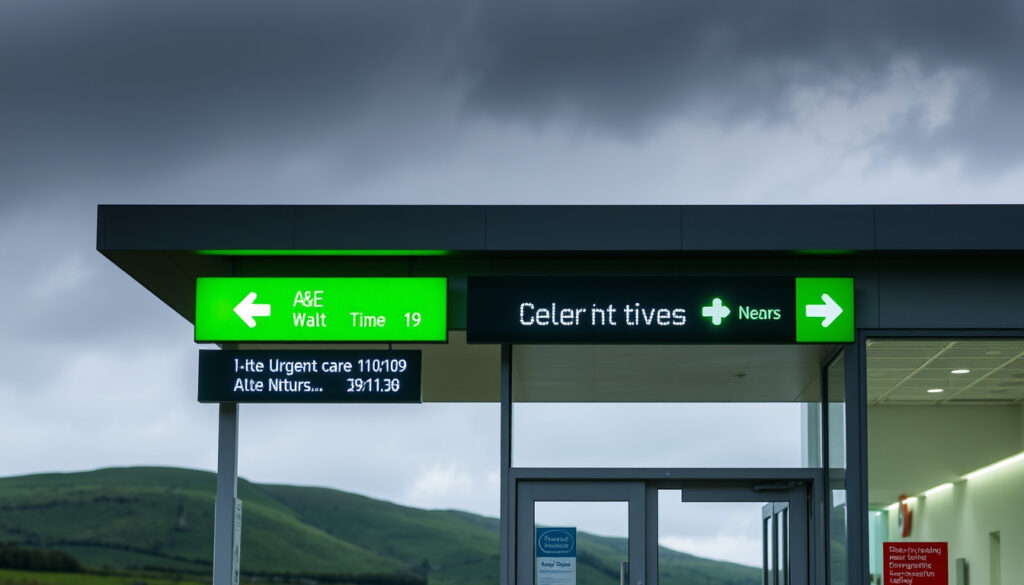
A and E Near Me: Ireland A&E Locations, Waits & Alternatives
If you’ve ever driven to a hospital wondering whether your injury really warranted the trip, you’re not alone. Irish emergency departments fielded 1.48 million attendances in 2023 alone, and roughly one in four of those cases were classified as standard or non-urgent. Knowing where to go—and when to pick up the phone instead—can mean the difference between a four-hour wait and being directed somewhere faster, closer, and cheaper.
A&E Open Hours: 24/7 · Primary Finder: HSE.ie urgent care search · Alternatives: Injury units, GP out-of-hours · NHS 111 Role: Call first for advice · Ireland Cost Note: Free for eligible
Quick snapshot
- A&E is free for public patients in Ireland (Health Service Executive)
- Call 111 before attending for non-emergencies (HSE A&E guidance)
- 23% of ED presentations were standard or non-urgent (HIQA Health Technology Assessment Draft Report)
- Exact waiting times vary by department and hour
- Ambulance charges differ by region and eligibility
- Telephone pathway rollout timeline under review
- HSE reviewing alternative telephone pathway for non-urgent calls
- More injury units may open if HIQA recommendation adopted
- Live waiting time dashboards expanding across sites
The table below consolidates the most-searched emergency care details, from unit locations to attendance volumes.
| Detail | Value |
|---|---|
| Main Finder | www2.hse.ie/services/find-urgent-emergency-care/ |
| Example Unit | Roscommon Injury Unit, 090 663 2212 |
| Walk-in Clinics | Laya Healthcare, Vhi 360 |
| Children’s ED | 24/7 at CHI sites |
| Ambulance calls (2022) | 384,000 (HIQA HTA Draft Report) |
| ED attendances (2023) | 1.48 million (HIQA) |
| Low-acuity ED share | 23% (Jan 2022–Oct 2024) (HIQA) |
| GP out-of-hours weekly contacts | 21,500 average (HIQA) |
When should I go to A&E?
A&E departments exist for life-threatening emergencies: severe bleeding, chest pain, difficulty breathing, signs of stroke, major fractures, or loss of consciousness. If your situation could deteriorate rapidly without hospital intervention, the emergency department is where you need to be.
Signs you need the ER
- Severe chest pain or pressure
- Sudden weakness, numbness, or difficulty speaking
- Serious head injuries or cuts needing stitches
- Persistent fever in young children or elderly patients
- Breathing difficulties or choking
- Signs of severe allergic reaction
According to the Health Information and Quality Authority (HIQA), an independent statutory body that promotes safety and quality in Irish health services, emergency departments are under significant pressure partly because people with non-urgent care needs often attend when they cannot or will not wait for other services (HIQA Health Technology Assessment Draft Report). Knowing the difference protects you—and keeps resources available for those who genuinely need them.
Alternatives like injury units
Injury units across Ireland handle fractures, sprains, minor burns, and wounds that need urgent care but are not life-threatening. These units operate with shorter waits and are staffed by senior nurses and doctors trained in emergency medicine. The HSE lists all injury unit locations at HSE.ie injury units page, where you can filter by county and opening hours.
The implication: choosing injury units over A&E for minor injuries directly reduces pressure on emergency departments while giving patients faster access to appropriate care.
Can I just turn up to A&E?
Yes—you do not need an appointment to attend an emergency department. Ireland’s A&E departments operate on a walk-in basis, open 24 hours a day, seven days a week. However, showing up does not guarantee you’ll be seen quickly.
Walk-in policy
Anyone can present to an A&E department without a referral. This open-door policy is a core principle of Ireland’s public healthcare system. Whether you arrive by ambulance, car, or on foot, you will go through triage on arrival to determine how urgently you need treatment.
Triage process
Upon arrival, a triage nurse assesses your condition using a standardised system. Patients are categorised by clinical priority, not by order of arrival. If you present with a minor ailment while patients with heart attacks or major trauma are waiting, you will be seen after them. This system saves lives but means those with non-urgent conditions can face extended waits—sometimes exceeding four or five hours during peak periods.
The implication: arriving at A&E without understanding the triage system sets unrealistic expectations. Patients with minor issues who arrive early expecting quick treatment often leave frustrated. An injury unit or GP out-of-hours service would serve them better.
Should I ring 111 before going to A&E?
For anything that is not a clear emergency, calling 111 before attending A&E is strongly recommended. The NHS 111 service (available across Ireland via the same number) provides 24/7 access to clinical advice that directs you to the right care setting.
NHS 111 vs A&E
NHS 111 connects callers to trained advisors who can arrange a callback from a clinician, recommend a GP appointment, direct you to a pharmacy, or advise on self-care. In genuine emergencies, they will dispatch an ambulance. For cases that need urgent care but not hospital-level intervention, they can book you into an injury unit or GP service.
When to call
- You are unsure whether your condition needs hospital care
- You need medical advice outside GP hours
- A child or elderly person has symptoms you cannot assess alone
- You have a minor injury and want to confirm the nearest open unit
- You suspect you need an ambulance but are uncertain
When people with acute, non-urgent care needs cannot access Injury Units or primary care in a timely way, they either go to an ED or call 112 or 999, according to HIQA’s evaluation team (Health Information and Quality Authority). This pattern drives unnecessary emergency department crowding.
Calling 111 first keeps emergency departments available for those who genuinely need them—and gets you to the right care faster. A quick phone call can shave hours off your wait and land you in a more appropriate setting.
The pattern: using 111 before travelling to A&E consistently leads patients to the most appropriate care setting while preserving emergency department capacity for life-threatening cases.
How much does A&E cost in Ireland?
A&E attendance in Ireland is free for public patients who hold a medical card or qualify under the NHS scheme. For those without a card, a standard emergency department charge applies for non-admitted treatment.
Costs for residents
Public patients with a valid medical card pay nothing for emergency department treatment. Those without a card face a charge of approximately €100–€150 for attendance, though this fee is waived if you are admitted to hospital as an inpatient. Children under 16 are generally exempt from charges at A&E.
GP out-of-hours services operate separately from A&E. If you contact a GP out-of-hours service and they refer you to A&E, standard A&E charges apply. However, if your GP out-of-hours consultation resolves your issue without a hospital visit, you pay only the GP out-of-hours consultation fee.
Ambulance fees
Ambulance transport to hospital is not free for everyone. While emergency ambulance calls are handled through the National Ambulance Service, patients transported by ambulance may receive a bill depending on their eligibility category and the circumstances of the call. The exact charge structure varies regionally, and it is advisable to confirm this with your health insurer or the HSE if cost is a concern.
The trade-off: choosing the right setting from the start avoids unnecessary charges. Attending injury units or GP services when appropriate means no A&E charge applies, and you receive care just as qualified for your situation.
How to get seen quicker in A&E?
There is no guaranteed shortcut to being seen faster in an emergency department, but understanding how the system works—and knowing your alternatives—can dramatically reduce your wait.
Best times to attend
Weekday mornings between 8am and 10am tend to see lower attendance than afternoon and evening slots. Mondays and Fridays typically experience higher volumes. Overnight (2am–6am) can be quieter if your condition is stable enough to tolerate a late visit, though fewer staff are on duty during these hours.
Use minor injury clinics
Minor injury clinics—formally called injury units—are the single most effective way to avoid A&E waits for non-life-threatening injuries. These units treat conditions including broken bones, sprains, minor burns, wound stitching, and foreign body removal. Staffed by senior emergency nurses and doctors, they offer same-day treatment without the emergency department .
The HSE operates injury units at locations including Roscommon (090 663 2212), and many more are listed on HSE.ie. Private health insurers including Laya Healthcare and Vhi also operate walk-in clinics that can serve minor injury needs.
The catch: injury units cannot treat life-threatening emergencies and their opening hours vary by location, so always confirm availability before travelling.
Upsides
- Injury units typically have shorter waits than A&E
- Staff are specialists in emergency care for non-life-threatening cases
- Available across Ireland in most counties
- Free for medical card holders
- No appointment needed for walk-in attendance
- Paediatric injury units operate at Children’s Health Ireland (CHI) sites
Downsides
- Not all injury units are open 24/7—hours vary by location
- Cannot treat life-threatening emergencies
- Capacity limits mean waits can still build during peak times
- Limited imaging equipment compared to full A&E
- Not available in every town or village
Finding the right care for your situation
Ireland’s emergency care system works best when patients self-select appropriately. Emergency departments are stretched: 1.48 million attendances in 2023, with 23% classified as standard or non-urgent, represents a system under genuine pressure. For minor injuries, sprains, non-complex fractures, and conditions that a GP could manage, injury units and GP out-of-hours services are faster and equally appropriate.
HIQA released a draft health technology assessment on 7 May 2025 proposing a 24/7 telephone pathway to direct non-urgent callers away from emergency departments. If adopted, this could reshape how patients access care over the coming years.
The implication: the proposed telephone pathway would give patients a structured first step before deciding whether A&E attendance is genuinely necessary.
Getting to the right place
The practical steps below walk you through finding emergency care in Ireland, from deciding whether A&E is necessary to locating the nearest injury unit and understanding what each option costs.
- Call 111 first. Describe your symptoms to a trained advisor. They will direct you to the most appropriate service—A&E, injury unit, GP, or pharmacy—without you having to guess.
- Check live waiting times. The HSE publishes real-time waiting figures for major emergency departments at HSE.ie. This helps you decide whether to travel to a specific site or wait for a quieter period.
- Use the HSE finder tool. Enter your county at www2.hse.ie/services/find-urgent-emergency-care/ to see all nearby injury units, urgent care centres, and A&E departments with their opening hours.
- Check your eligibility for free care. If you hold a medical card or qualify under the European Health Insurance Card scheme, you are entitled to free emergency department treatment. Bring your card with you.
- For children’s emergencies, go to CHI sites. Children’s Health Ireland operates dedicated paediatric emergency departments at three Dublin locations, open 24/7, staffed by specialists in child health emergencies.
For Dublin residents specifically, HSE emergency department listings cover Connolly Hospital Blanchardstown, Mater Misericordiae University Hospital, St James’s Hospital, Tallaght University Hospital, and Mercy University Hospital—all with their own live waiting time dashboards.
“Provision of an alternative telephone pathway is intended to support the timely provision of care in the most appropriate setting,” stated HIQA (the Health Information and Quality Authority, an independent statutory body) in its May 2025 draft report. For patients today, that pathway already exists in the form of 111—using it before you drive to A&E is the simplest thing you can do.
When primary care services and Injury Units cannot be readily accessed, people with acute, non-urgent care needs who are unwilling or unable to wait either go to an ED or call 112 or 999.
— HIQA Evaluation Team, Health Technology Assessment Draft Report
The alternative telephone pathway aims to direct patients to appropriate settings like Injury Units instead of EDs.
— Dr Rosa McNamara, National Clinical Lead for HSE National Clinical Programme — Emergency Medicine, HIQA Health Technology Assessment Draft Report
The pattern is clear: Irish emergency departments are treating a significant number of cases that injury units or GP services could handle. For patients, the practical consequence is straightforward—calling 111 first and using injury units for minor injuries protects the system and gets you seen faster. For policymakers, the data from HIQA makes a strong case for expanding injury unit capacity and accelerating the telephone pathway proposal.
For patients, the most immediate action is to call 111 before driving to A&E—this single step directs you to the most appropriate care setting and preserves emergency department capacity for those who genuinely need it.
Related reading: The Works Near Me – Stores, Hours & Deals · The Works Near Me – Addresses, Hours, Sales Guide
jstor.org, shisiradhikari.com, oecd.org, drugsandalcohol.ie, failteireland.ie, era.europa.eu, daanow.org
For sprains or minor issues that don’t require full A&E attention, nearby urgent care centres offer faster assessments and avoid lengthy queues.
Frequently asked questions
What are signs you need a check-up?
Persistent fever lasting more than three days, unexplained weight loss, blood in urine or stool, chest discomfort during exertion, sudden vision changes, or any symptom that has worsened over two weeks without improvement warrant a GP appointment. For acute symptoms like severe pain, breathing difficulty, or sudden confusion, call 111 immediately.
Do you need to pay if you call an ambulance?
Ambulance fees vary by region and eligibility. Medical card holders generally receive free ambulance transport for emergency calls. Those without a card may face charges depending on the circumstances and their health insurer. Contact the National Ambulance Service or your insurer directly to confirm your position before a non-emergency transport situation arises.
How to organise transport to hospital?
For genuine emergencies, call 112 or 999 and an ambulance will be dispatched. For non-emergency transport between hospitals or to scheduled appointments, contact the HSE Patient Transport Service if you qualify under medical criteria. Private ambulance services also operate but charge fees.
What is the nearest minor injury clinic?
Enter your county at HSE.ie injury units to find all minor injury clinics near you, along with opening hours and contact details. Examples include Roscommon Injury Unit (090 663 2212), St Mary’s Hospital (Navan), and Bantry General Hospital.
Where is A&E in Blanchardstown?
Connolly Hospital Blanchardstown operates a 24/7 emergency department located at Mill Road, Blanchardstown, Dublin 15. It is one of the busiest in the Dublin region. Live waiting times are published on the HSE emergency care dashboard.
Best time to go to A&E in Ireland?
Weekday mornings between 8am and 10am typically see lower attendances. Avoid Mondays and Friday afternoons. If your condition is not an emergency, using an injury unit or GP out-of-hours service during these hours will almost always result in a shorter wait than attending A&E.
What are live A&E waiting times in Dublin?
The HSE publishes real-time waiting data for all major emergency departments in Dublin and nationwide at HSE.ie. This dashboard shows current wait times for each site, updated throughout the day, helping you choose the shortest option if you need to attend.
More related posts
 What Is Amoxicillin Used For – Uses, Dosage, Side Effects
 UK Amber Weather Warning Thunderstorms: Met Office Alerts
 Jamie Murray Divorce, Relationship, Children, Net Worth (2026)
 Class Charts Parent Login – Step-by-Step Guide
 Leyton Orient F.C. – History League Two Status Key Facts
 Iain Armitage: Age, Net Worth, and the Nepo Baby Question
 Adriana Lima: Biography, Children & Career Facts
 BBC Scottish Football Gossip: Latest Rumors & Transfers